
PVG/c
PVG/c
| Strain details | |
|---|---|
| Nomenclature | PVG/cOzarc |
| Common name | PVG/c |
| Synonyms | PVG |
| Strain | Inbred |
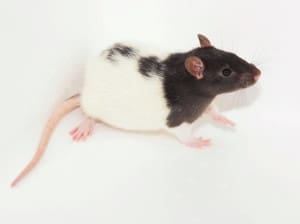
| Coat colour | White with black hood (a, B, C, h) |
| Species | Rat |
| Genetic background | - |
| Location | Area Oz4 |
| Weekly wean target | <10 males, <10 females |
Strain description
- MHC Haplotype RT1c
- Animals are docile and has very good breeding performance.
- Popular inbred for general use as low activity relative to other strains.
- Resistant to experimental allergic encephalomyelitis and the induction of autoimmune thyroiditis.
- Useful model for development of autoimmune thyroiditis and diabetes due to insulitis following thymectomy and sublethal x-irradiation.
- Originally inbred by Glaxo, UK (1946) from stock originating from King College of Household Science to Lister Institute, to Virol to Glaxo (P = Piebald, V = Virol, G = Glaxo, C = ARC Compton where a recognised subline developed). CSIRO from Glaxo, UK.
- To Murdoch University from John Curtin School of Medical Research, Canberra, Australia as F13+ (1976). JCSMR from CSIRO, NSW Australia as F20 (1970).
- Animal Resource Centre (ARC), Western Australia received stock strain from Murdoch University, Perth, Australia as F12 (1981). Caesarean derived to SPF status (1981).
- Strain is transferred to Ozgene ARC in 2023.
- Application: Useful model for development of autoimmune thyroiditis and diabetes due to insulitis following thymectomy and sublethal x-irradiation.
| PVG | PVG/cOzarc | |
|---|---|---|
| WKS | MALE | FEMALE |
| 3 | 26 - 57 | 26 - 50 |
| 4 | 42 - 85 | 25 - 86 |
| 5 | 65 - 121 | 56 - 96 |
| 6 | 78 - 156 | 81 - 113 |
| 7 | 97 - 185 | 99 - 135 |
| 8 | 144 - 215 | 109 - 151 |
| 9 | 172 - 229 | 124 - 155 |
| 10 | 170 - 237 | 120 - 163 |
| 11 | 174 - 252 | 133 - 174 |
| 12 | 191 - 259 | 148 - 186 |
| 13 | 188 - 274 | 148 - 181 |
| 14 | 196 - 282 | 146 - 180 |
Past ARC reports:
Current Ozgene ARC reports (from 01-Jun-2023)
- This strain is housed in Area Oz4
- Please see Oz4 health reports on our Biosecurity page
- Animals are not allowed to be used for propagation.
- Ozgene ARC terms and Conditions
- Mouse images are representative only. Actual phenotypes may vary based on genotype, sex, age, husbandry, health status, and other factors.